Author: maria

Reckless Driving in Virginia

What is Reckless Driving in Virgina?

Reckless driving in Virginia involves operating a vehicle in a way that endangers life, limb, or property. It is classified as Class 1 misdemeanor and carries significant penalties such as like large fines, jail time and license suspension.

The definition is intentionally broad meaning police, and the courts can look at how you were driving and whether your conduct created a real risk to others. Factors such as speed, loss of control, erratic maneuvers, and failure to follow traffic laws are considered when determining if driving was reckless.

What Are the Different Types of Reckless Driving in Virginia?

The most commonly recognized form of reckless driving in Virginia is speed-related reckless driving. In the state, driving 20 miles per hour or more over the posted speed limit, or exceeding 85 mph regardless of the speed limit, is automatically considered reckless driving.

Other forms of reckless driving include:

  • Driving too fast for conditions (even if you’re below the posted limit), such as in heavy rain, fog, ice, or heavy traffic (VA Code § 46.2-861)
  • Not maintaining proper control or driving with faulty/inadequate brakes (VA Code § 46.2-853)
  • Driving with an obstructed view or impaired control (for example, overloaded vehicle or too many people in the front seat) (VA Code § 46.2-855)
  • Failing to give proper and timely turn/stop signals when required (VA Code § 46.2-860)
  • Dangerous driving on certain non-highway premises open to the public (like school or church driveways, business/government parking lots, and roads under construction) (VA Code § 46.2-864)
  • Racing or “exhibition driving” on highways or qualifying public-access property without authorization (VA Code § 46.2-865)

It is also important to note that you can still be charged with reckless driving for any manner of driving that endangers life, limb, or property can qualify (VA Code § 46.2-852).

What Are the Consequences for Reckless Driving in Virginia?

A standard reckless driving conviction in Virginia is a Class 1 Misdemeanor, the most serious type of misdemeanor. Potential consequences can include:

  • Up to 12 months in jail
  • Up to $2,500 in fines
  • License suspension
  • Six demerit points in your Virginia driving record

What are Common Defenses for a Reckless Driving Case in Virginia?

Every reckless driving case in Virginia is highly fact-specific, so it is crucial to consult an experienced traffic attorney. Skilled attorneys bring in-depth knowledge of Virginia traffic laws, understand relevant case precedents, and can conduct a thorough assessment of your situation. Common defenses include speed measurement challenges, disputes over the actual driving conditions, or questions about the officer’s or prosecution’s evidence. Attorneys can also present mitigating factors such as a clean driving record, completion of a driver improvement course, or community involvement to strengthen your defense or negotiate alternative sentencing options.

What Should You Do if You Are Charged with Reckless Driving in Virginia?

Being charged with reckless driving in Virginia is serious and can carry significant fines, license suspension, and even jail time. It is important that you reach out to an experienced traffic attorney to prepare a defense.

CALL OR TEXT NOW
757-929-0335

Book a FREE Case Evaluation Now!

Your Name(Required)
In which city or county did you recieve your ticket?(Required)
Please note that we are only accepting cases in the above jurisdictions at this time.
EX: Reckless driving, DUI/DWI, eluding, hit and run, simple speeding, etc.

By providing your phone number, you agree to receive SMS updates, reminders, and important notifications from McCormick Law, PC d/b/a Driving Defense Law. Standard messaging rates may apply. You can opt out at any time by replying “STOP” to any message. View our Privacy Policy.

Opt In

Disclaimer: No attorney-client relationship exists or should be assumed as a result of this communication. By submitting this form, you are opting into our mailing list (your information will not be shared with anyone else).

Disclaimer

Speeding

What are the different types of speeding violations in Virginia?

Speeding tickets are no fun. If you find yourself holding a speeding ticket, you may want to simply pay the fine or explore other options. Driving Defense Law will help you navigate these options so that your speeding ticket doesn’t result in a long-term consequence.

Virginia defines several types of speeding violations. Including:

Speeding Generally over the Speed Limit$6 per
Speeding School Buses over the Speed Limit $6 per
Speeding Special Permit Vehicles over the Speed Limit $6 per
Speeding in School Zone over the Speed Limit $7 per
Speeding in Business/Residential Districts per mph over the Speed Limit $6 per
Speeding Passenger Vehicles with Trails over the Speed Limit $6 per
Exceeding Speed Limit Set by DOT over the Speed Limit $6 per
Speeding in a Work Zone over the Speed Limit $7 per
Speeding Certain Residential Zone (+ $8 per) $200
Speeding in Certain Bridges/Tunnels over the Speed Limit$6 per

Processing Fees/Court Costs of Speeding in Virginia

  • $62.00 for the first charge
  • $11 for each additional charge with the same court date
  • The worst maximum fine is $250 in addition to the $62 processing fee.
  • If the driver does not prepay the speeding ticket and does not appear in court there is an additional $35 fee.

A conviction on a basic speeding ticket normally amounts to a fine and a court fee. The fines are broken down above. However, you should know that a speeding ticket will also get you demerit points on your driving record. The number of points depends on the severity of speeding.

Demerit Points – Virginia DMV

Demerit points are assigned when you are convicted of a traffic violation. Each time that you commit a traffic offense, the DMV adds demerit points to your record. Different violations amount to different point assignments.

If you are convicted of a traffic violation, the court will notify the Department of Motor Vehicles who then:

  1. Posts the conviction to your driving record
  2. Assigns demerit points
  3. (if applicable) issues an order of suspension
  4. (if applicable) issues an order requiring the completion of a driver improvement clinic
  5. Notifies your insurance company

Note: Demerit points can also be added to your record for traffic convictions incurred in other states

Breakdown of Demerit Points

(the number of years that the conviction stays on your DMV record is in parentheses)

Speeding 1-9 mph above the posted speed limit (5 years) 3 points
Impeding traffic – slow speed (5 years) 3 points
Speeding 10-19 mph above the posted speed limit (5 years) 4 points
Speeding more than 20 mph over the limit (can stay for up to 11 years)6 points

Virginia Code

46.2-870 Maximum Speed Limits Generally – § 46.2-870. Maximum speed limits generally (virginia.gov) 
46.2-878.3 Prepayment of fines for violations of speed limits – § 46.2-878.3. Prepayment of fines for violations of speed limits (virginia.gov)
  • Fine of $6 per mile per hour in excess of posted speed limits
  • Fine of $7 per mile per hour in excess of posted speed limits for violation of 46.2-873 (school crossing zone) and 46.2-878.1 (highway work zone)
  • Fine of + $8 per mile per hour in excess of posted speed limits for a violation of 46.2-878.2 (the maximum speed limit in certain residence districts of counties, cities, and towns). The $8 per is an addition to a $200 fine.
  • Any person who drives in excess of 80 miles per hour but less than 86 miles per hour on any highway having a speed limit of 65 miles per hour is subject to an additional $100 fine

What is a DUI in Virginia?

A DUI (Driving Under the Influence) occurs when you operate a vehicle with a BAC (Blood Alcohol Concentration) of 0.08% or higher, or with detectable controlled substances in your system. Including:

  • 0.02 milligrams of cocaine
  • 0.1 milligrams of methamphetamine
  • 0.01 milligrams of PCP (phencyclidine)
  • 0.1 milligrams of MDMA (3,4 methylenedioxymethamphetamine)

What Are the Penalties for a First DUI?

First-time DUI penalties include:

  • Fines of $250-$2,500
  • Up to 12 months in jail
    • BAC of .15%-.20% – 5-day mandatory jail time
    • BAC of .20% or above– 10-day mandatory jail time
  • One-year license revocation
  • Completion of VASAP (Virginia Alcohol Safety Action Program)

What Are the Penalties for a Second DUI?

Penalties for a second DUI in Virginia are more severe and vary based on how long it has been since your first conviction.

Second DUI within less than 5 years:

  • Fines of $500-$2,500
    • BAC of .15% or above– $1,000 minimum fine
  • Up to 12 months in jail, with a mandatory of 20 days
    • BAC of .15%-.20% – 30-day mandatory jail time
    • BAC of .20% or above– 40-day mandatory jail time
  • Three-year license revocation
  • Completion of VASAP (Virginia Alcohol Safety Action Program)

Second DUI within 5-10 years:

  • Fines of $500-$2,500
    • BAC of .15% or above– $1,000 minimum fine
  • Up to 12 months in jail, with a mandatory of 10 days
    • BAC of .15%-.20% – 20-day mandatory jail time
    • BAC of .20% or above– 30-day mandatory jail time
  • Three-year license revocation
  • Completion of VASAP (Virginia Alcohol Safety Action Program)

What Are the Penalties for a Third DUI?

A third DUI in Virginia is treated as a felony and also carries more severe penalties based on how long it has been since your last DUI conviction.

Third DUI within less than 5 years:

  • Fines of $1,000-$2,500
  • Up to 1-5 years in prison OR 1 year in jail
    • Mandatory of 6 months
  • Indefinite license revocation

Third DUI within 5-10 years:

  • Fines of $1,000-$2,500
  • Up to 1-5 years in prison OR 1 year in jail
    • Mandatory of 90 days
  • Indefinite license revocation

What Are the Penalties for a Fourth (or subsequent DUI)?

Penalties for a fourth or subsequent DUI include:

  • Fines of $1,000-$2,500
  • Up to 1-5 years in prison OR 1 year in jail
    • Mandatory of 1 year
  • Indefinite license revocation

What Should You Do After a DUI?

If you are charged with a DUI, take action immediately. Call a Driving Defense Law attorney at 757-929-0335 or book a consultation today to protect your rights, minimize penalties, and safeguard your driving privileges. Early representation can make a critical difference in the outcome of your case.

Following Too Closely

How is “following too closely” defined in the state of Virginia?

“The driver of a motor vehicle shall not follow another vehicle, trailer, or semitrailer more closely than is reasonable and prudent, having due regard to the speed of both vehicles and the traffic on, and conditions of, the highway at the time.” § 46.2-816

The maximum punishment for following too closely is a $250 fine and court costs of approximately $67. The charge is also prepayable for a fine of $30. However, be aware that prepaying is treated as an admission of guilt.

Demerit Points

If convicted of following too closely expect to have 4 demerit points added to your record. See the following:

Following too closely (3 years) 4 points

Hit and Run Laws in Virginia

What is Considered a Hit and Run in Virginia?

“The driver of any vehicle involved in an accident in which a person is killed or injured in which an attended vehicle or other attended property is damaged shall immediately stop as close to the scene of the accident as possible without obstructing traffic.” Virginia Code § 46.2-894

A driver can be charged with a hit and run if the driver fails to stop at or return to the scene of the accident or the driver fails to report the accident to police or exchange their information with the other people or property involved.

What to Do if You’re Involved in a Hit and Run

If you are involved in an accident you must report: (report to state police or law enforcement agency; the person struck and injured; the driver or other occupants involved in the collision)

  • Your Name
  • Your Address
  • Your Driver’s License Number
  • Your Vehicle Registration Number

As soon as practical following the crash, you should provide reasonable assistance to any person injured in the accident.

If the accident involves an unattended vehicle, the driver must make a reasonable attempt to find the owner of the property and report the accident. If the driver cannot find the owner, the driver must leave his contact information at the scene of the accident. The driver must then also report the accident within 24 hours to state or local police. Virginia Code § 46.2-896

Misdemeanor v. Felony Hit and Run

A hit and run will be charged as either a Class 1 misdemeanor or a Class 5 felony.

  • Class 1 misdemeanor – the accident results in property damage of $1,000 or less
    • Penalty – up to one year in jail and a fine up to $2,500
  • Class 5 felony – the accident results in more than $1,000 of property damage or in bodily injury or death
    • Penalty – up to 10 years in prison and a fine of up to $2,500

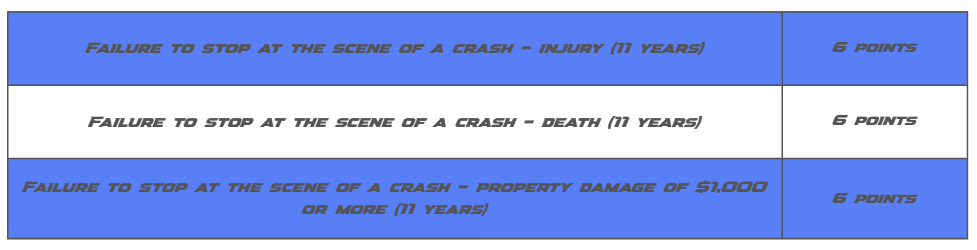
If you are convicted of a hit and run, you should expect six demerit points to be added to your record. See the following:

Eluding

Eluding the police is when a person continues to drive in a willful and wanton manner disregarding the police officer’s signal.

To be convicted of eluding, the Commonwealth must prove the individual heard the signal or saw the lights and knew that the person signaling him was a police officer, and then disregarded the signal by continuing to drive. The Commonwealth can also prove this by showing evidence that the individual fled on foot after stopping the vehicle.

An affirmative defense to eluding is that the person reasonably believed that he or she was being chased by someone who was not a law enforcement officer.

Penalties for Eluding the Police in Virginia

Misdemeanor

Eluding is charged as a Class 2 misdemeanor. A conviction for misdemeanor eluding is potential jail time of up to six months and a possible fine of $1,000.

The individual may also have a suspension of driving privileges for 30 days to a year if convicted of eluding. If during the eluding the individual’s speed exceeds the posted limit by 20mph, then the minimum license suspension is 90 days.

The individual may also be charged with any criminal offense they commit in addition to eluding.

Felony

Eluding is charged as a felony offense if it results in the risk of accident or injury involving the law enforcement officer. If an individual continues to drive intentionally and recklessly that could create a danger, the person will be charged with a Class 6 felony.

An individual convicted of felony eluding may endure a penalty of one to five years in prison in addition to a possible fine of up to $2,500.

If an officer is killed because of pursuing an eluding individual, the charge is a Class 4 felony. The penalty carries a two to ten year prison sentence and a possible fine of up to $100,000.

The individual may also have a suspension of driving privileges for 30 days to a year if convicted of eluding. If during the eluding the individual’s speed exceeds the posted limit by 20mph, then the minimum license suspension is 90 days.

Virginia Code

46.2-817 Disregarding Signal by Law Enforcement Officer to Stop; Eluding Police; Penalties – § 46.2-817. Disregarding signal by law-enforcement officer to stop; eluding police; penalties (virginia.gov)

Texting While Driving 

According to the Virginia Code, it is unlawful for anyone to hold a handheld personal communications device while driving a motor vehicle.

A first time offense will result in a $125 fine. A second offense will result in a $250 fine. If convicted of texting while driving, expect three demerit points to be added to your record.

Virginia Code

46.2-818.2 Use of Handheld Personal Communications Devices – § 46.2-818.2. Use of handheld personal communications devices in certain motor vehicles; exceptions; penalty (virginia.gov)
  • It is unlawful for any person, while driving a moving motor vehicle on the highways in Virginia to hold a handheld personal communications device
  • A violation could result in a fine of $125 (first offense) or a fine of $250 (second offense)

As of January 1, 2021 Virginia prohibits drivers from holding cell phones or any other wireless communication devices while driving except in a driver emergency or the vehicle is lawfully parked or stopped. Virginia Department of Motor Vehicles

The Points System in Virginia

The Virginia Department of Motor Vehicles utilizes a point system to rate drivers.

A driver will receive demerit points for unsafe driving and safe driving points for good driving. Demerit points stay on the driver’s record for two years from the date the driver commits the offense. The length of time that a conviction stays on the driver’s record depends on the severity of the violation.

One safe driving point is added each full calendar year that a driver holds a valid Virginia driver’s license and drives without any violations or suspensions. A driver can accumulate up to five safe driving points. Safe driving points are awarded in early April of each year.

Demerit points are assigned when a driver is convicted of a traffic violation. Demerit points range from three to six points. The following list groups traffic violations that warrant demerit points. The years in the parentheses indicate the number of years the conviction stays on the driver’s DMV record.


Three Point Violations:

Speeding:

  • Speeding 1-9 mph above the posted speed limit (5 years)
  • Impeding traffic, slow speed (5 years)

Passing/Driving:

  • Improper passing (3 years)
  • Improper passing on the right (3 years)
  • Improper driving (3 years)
  • Improper stopping on highway (3 years)
  • Changing course after signaling (3 years)
  • Coasting with gears in neutral (3 years)
  • Failure to give way in favor of overtaking vehicle (3 years)
  • Failure to give way when abreast of another car (3 years)
  • Driving through safety zone (3 years)
  • Driving over fire hose (3 years)
  • Unauthorized use of crossover on controlled highway (3 years)
  • Driving/riding on sidewalk (3 years)

Turning/Backing:

  • Improper turn (3 years)
  • Improper U-turn (3 years)
  • Violation of right turn on red (3 years)
  • Violation of left turn on red (3 years)

Signs/Signals:

  • Failure to obey highway sign (3 years)
  • Evading traffic control device (3 years)

Lights:

  • Driving without lights/excessive lights (3 years)
  • Failure to dim headlights (3 years)
  • Parking without proper lights displayed (3 years)
  • Inadequate hazard lights (3 years)

Licenses/Permits:

  • No Virginia driver’s license (3 years)
  • No Virginia license plate (3 years)
  • Failure to obtain a driver’s license (3 years)
  • No driver’s license – vehicle/motorcycle (3 years)
  • Failure to have license revalidated (3 years)
  • Learner’s permit violation (3 years)
  • Permitting unlicensed person to drive (3 years)
  • Driving in violation of restricted license (restrictions related to physical limitation, such as mechanical control device) (3 years)

Commercial Motor Vehicles:

  • Driving commercial motor vehicle with alcohol in blood (*)
  • Driving commercial motor vehicle without license (3 years)
  • Driving commercial motor vehicle with more than 1 driver’s license (3 years)
  • Driving commercial motor vehicle without endorsement(s) (3 years)
  • Driving commercial motor vehicle without license in possession (3 years)
  • Commercial driver’s license/commercial learner’s permit violation (3 years)
  • Driving commercial motor vehicle in left lane of interstate (3 years)
  • Driving in excess of 13 hours in a 24-hour period (3 years)
  • Driving public passenger-carrying vehicle under age (3 years)
  • Driving bus transporting school children without a safety belt (3 years)
  • Driving school bus without license (3 years)
  • Driving school bus under age (3 years)
  • Vehicle height exceeds limit for tunnels (3 years)
  • Texting while driving in a commercial motor vehicle (5 years)

Other Violations:

  • Failure to stop at the scene of a crash, unattended property (3 years)
  • Failure to leave the scene of a crash at the direction of officer (3 years)
  • Failure to report a crash, unattended property, less than $250 damage (3 years)
  • Following/parking within 500 feet of fire apparatus (3 years)
  • Emergency vehicle violation (3 years)
  • Drinking while driving (3 years)
  • Improper driving/riding motorcycle (3 years)
  • Driving with TV screen visible to driver (3 years)
  • Driving while using earphones (3 years)
  • Passenger restriction violation (3 years)
  • Curfew violation (3 years)
  • HOV violation, second or subsequent offense – Northern Virginia planning district 8 (5 years)
  • Use of Handheld Communications Device (3 years)

Four Point Violations:

Reckless Driving/Speeding:

  • Reckless driving – failure to stop before entering a highway (11 years)
  • Speeding (5 years)
  • Speeding 10-14 mph above the posted speed limit (5 years)
  • Speeding 15-19 mph above the posted speed limit (5 years)
  • Speeding 10-19 mph above the posted speed limit (5 years)

Passing:

  • Passing when unsafe (3 years)
  • Passing to the left of approaching vehicle (3 years)

Stopping/Yielding:

  • Failure to drive to the right and stop for police/fire/emergency vehicle (3 years)
  • Failure to stop for pedestrian (3 years)
  • Failure to stop and yield right-of-way (3 years)
  • Failure to yield right-of-way (3 years)
  • Failure to yield when turning left (3 years)
  • Failure to yield to funeral procession (3 years)

Keeping to the Right:

  • Failure to drive on right half of highway or street (3 years)
  • Failure to keep to the right when crossing an intersection (3 years)
  • Driving to the left of rotary traffic island (3 years)

Following/Signaling:

  • Following too closely (3 years)
  • Failure to signal before moving from curb (3 years)
  • Improper signal (3 years)

Railroad Crossings:

  • Failure to obey railroad crossing signal (3 years)
  • Failure to stop at railroad grade crossing (3 years)
  • Failure to keep to the right at a railroad crossing (3 years)
  • Failure to stop passenger-carrying vehicle at railroad grade crossing (3 years)
  • Railroad crossing/stopping (3 years)
  • Improper operation of crawler-type tractor over railroad crossing (3 years)

Railroad Crossings (Commercial Motor Vehicle Drivers):

  • Failure to slow down/stop at a railroad crossing (*)
  • Failure to have sufficient space to drive through a railroad crossing (*)
  • Failure to obey traffic control device or enforcement official at a railroad crossing (*)
  • Failure to have sufficient undercarriage clearance at a railroad crossing (*)

Other Violations:

  • Operating a motor vehicle while suspended/revoked/restricted with a blood alcohol content of .02% or more (11 years)
  • Failure to stop at the scene of a crash, unattended property, damage in excess of $500 (11 years)
  • Passing stopped school bus (non-reckless) (3 years)
  • Failure to stop at the scene of a crash, property damage (3 years)
  • Emergency vehicle violation – property damage (5 years)
  • Emergency vehicle violation – injury (5 years)
  • Aggressive driving (5 years)
  • Failure to obey traffic signal (3 years)
  • Failure to obey lane directional signal (3 years)
  • Failure to obey highway lane markings (3 years)
  • Improper backing, stopping or turning (3 years)
  • Driving the wrong way on one-way highway or street (3 years)
  • Impeding/disrupting funeral procession (3 years)
  • Disregarding police officer’s signal to stop (3 years)
  • Disregarding crossing guard/officer’s signal (3 years)
  • Vulnerable Road User (5 years)

Six Point Violations:

Reckless Driving (Felony or Misdemeanor):

  • Reckless driving – speeding in excess of 85 mph (11 years)
  • Reckless driving – speeding 20 mph or more above the posted speed limit (11 years)
  • Reckless driving – racing (11 years)
  • Reckless driving – passing or overtaking an emergency vehicle (11 years)
  • Reckless driving – passing a school bus (11 years)
  • Reckless driving – passing on the crest of a hill (11 years)
  • Reckless driving – passing at a railroad crossing (11 years)
  • Reckless driving – passing two vehicles abreast (11 years)
  • Reckless driving – driving two vehicles abreast (11 years)
  • Reckless driving – driving too fast for conditions (11 years)
  • Reckless driving – failing to give a proper signal (11 years)
  • Reckless driving – faulty brakes/improper control (11 years)
  • Reckless driving – on parking lots, etc. (11 years)
  • Reckless driving – with an obstructed view (11 years)
  • Reckless driving – generally (11 years)
  • Speeding 20 mph or more above the posted speed limit (5 years)

Driving Under the Influence:

  • Driving while intoxicated (11 years)
  • Driving under the influence of alcohol or drugs (11 years)
  • Driving under the influence of drugs (11 years)
  • Driving after illegally consuming alcohol (persons under age 21) (3 years)
  • Driving while intoxicated – maiming (11 years)
  • Involuntary manslaughter/alcohol (11 years)
  • Refusing blood/breath test (11 years)
  • Driving while your license is suspended or revoked for driving while intoxicated (11 years)
  • Driving while your license is revoked for driving while intoxicated – maiming (11 years)
  • Driving while your license is revoked for driving while intoxicated – involuntary manslaughter (11 years)

Manslaughter:

  • Manslaughter (11 years)
  • Involuntary manslaughter (11 years)
  • Involuntary manslaughter/aggravated (11 years)

Habitual Offenders:

  • Driving after being declared a habitual offender (11 years)
  • Authorizing person suspended for habitual offender and/or driving while intoxicated to drive (3 years)

Licenses/Permits:

  • Driving on suspended license (11 years)
  • Driving while your license is suspended or revoked (11 years)
  • Driving under suspension or revocation before giving proof of financial responsibility (11 years)

Commercial Motor Vehicles:

  • Driving commercial motor vehicle while disqualified (*)
  • Driving commercial motor vehicle with blood alcohol .04 or more (*)
  • Driving commercial motor vehicle with blood alcohol .08 or more (*)
  • Driving commercial motor vehicle under influence of drugs (*)
  • Driving commercial motor vehicle under influence of drugs/alcohol (*)
  • Refusing blood/breath test while operating commercial motor vehicle (*)
  • Violating out of service order (11 years)

Other Violations:

  • Speeding 20 mph or more above the posted speed limit (5 years)
  • Injuring person while racing – felony (11 years)
  • Failure to stop at the scene of a crash – injury (11 years)
  • Failure to stop at the scene of a crash – death (11 years)
  • Failure to stop at the scene of a crash – property damage of $1000 or more (11 years)
  • Emergency vehicle violation – death (11 years)
  • Vehicular assault or willful stopping, impeding or damaging vehicle (11 years)
  • Blocking access to service facility (11 years)
  • Attempting to elude police
    • felony offense (11 years)
    • misdemeanor offense (3 years)
  • Operating unsafe vehicle (3 years)